

Executive Summary
Your concept at a glance


This downloadable business plan for additive construction includes a fully editable Word document and a detailed financial model template.
Your concept at a glance
What you sell and why
Market size and rivals
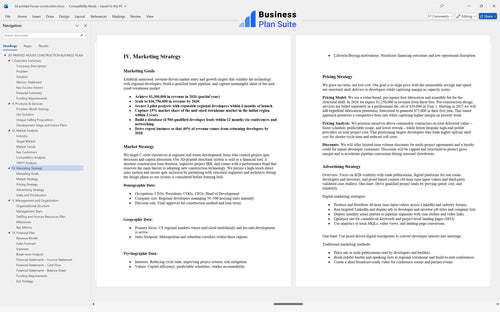
Channels, promotions, conversions
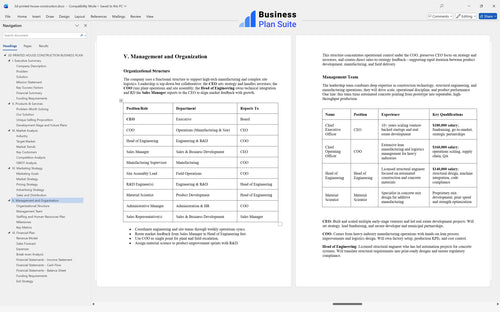
Team roles and org chart
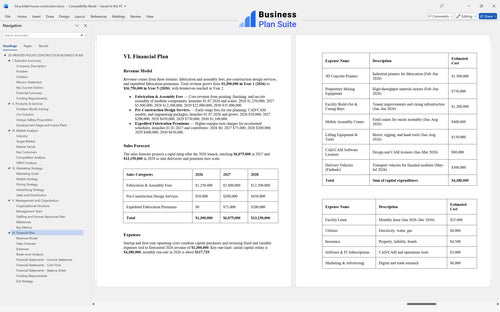
P&L cash flow break-even
You need a plan that's both credible and practical. We built this 3D printing construction business plan in Microsoft Word using our own industry research. All chapters are pre-populated with data specific to this business model-from market analysis to financial projections-and are fully editable to fit your strategy. The included financial model projects aggressive but achievable growth, scaling from $1.3M in first-year revenue to over $36M by Year 5.
Your primary customer is a regional residential developer or build-to-rent operator. Their biggest problem is unpredictable construction timelines caused by weather delays and skilled labor shortages, which slows down their capital deployment and hurts profitability. You solve this by offering a guaranteed structural shell completion within 10 days, decoupling their build schedule from these common risks.
The timing is right because the persistent housing crisis and a shortage of skilled construction labor have created a massive demand for faster, more reliable building methods. This is not a small niche; it's a fundamental shift in construction. The financial opportunity is significant, with a clear path to scale from $1.3M in revenue in your first year of operations to $36.75M by Year 5.
Yes, but it's a capital-intensive model that requires a significant upfront investment. Your minimum cash need will be over $1.6M to cover the heavy initial CapEx for printers and facility build-out. The good news is that the business is projected to reach its break-even point in Year 2. Here's the quick math for that year: at $6.075M revenue and a ~60% cost of goods, your gross margin is ~40%. After another ~4.4% in variable costs, your contribution is around 35.6%. With fixed overhead and salaries around $1.4M, you're defintely profitable, on track for an EBITDA of $14.29M by Year 5.
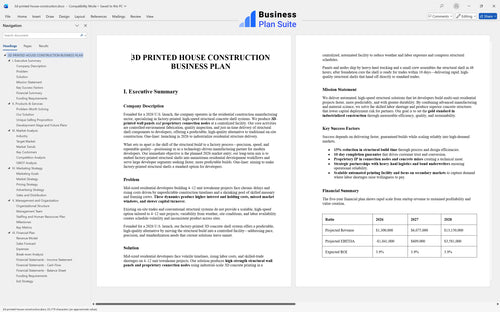
This pre-written business plan for 3D printed homes saves you dozens of hours. It's a comprehensive, fully researched document that you can immediately use and tailor to your specific additive manufacturing construction business plan. The entire template is 100% editable in Microsoft Word, ensuring your final plan aligns with your unique vision while meeting professional standards.
The house construction business plan template includes high-level financial tables for your Profit & Loss, Cash Flow, and Balance Sheet. These projections are built into the Word document, providing a clear financial outlook tailored to the concrete 3D printing business plan. This helps you present a credible and data-driven case to investors and lenders.
Developing a professional construction technology business plan doesn't have to be expensive. This template provides a cost-effective solution that delivers a polished, lender-friendly document without the high fees of hiring a consultant. This allows you to invest your capital into what really matters-growing your business.
Your goal is to secure funding, and this investment proposal for 3D printed housing is designed to help you succeed. The professional formatting, clear structure, and data-backed sections communicate your vision and viability effectively. It's built to give banks and investors the confidence they need to back your venture.
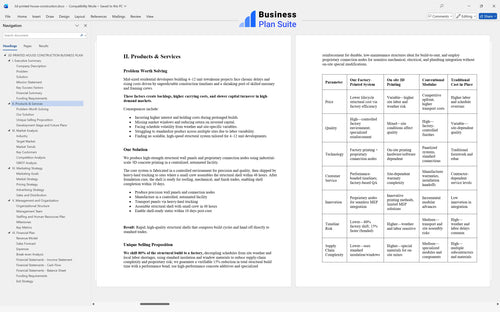
This template provides a complete strategic foundation for your business. It includes dedicated sections for your Mission, Vision, Target Market, and Value Proposition, ensuring you present a clear and cohesive story. Every critical component of a successful prefabricated housing business plan is already outlined for you.
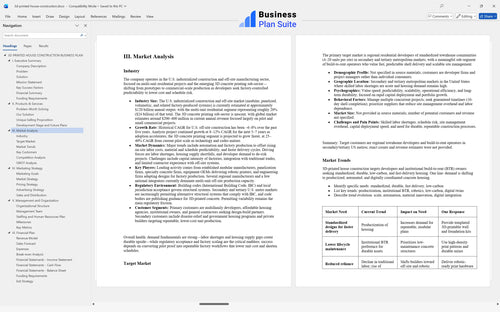
Understanding the market is critical. This section provides a comprehensive analysis of the 3D printed house construction industry landscape, including key statistics, trends, and a competitor overview. It gives you the information needed to effectively position your sustainable construction business model for success.
A great idea requires solid execution. The operations plan outlines key workflows, staffing strategies, and logistical considerations to manage your company effectively. This section of the automated construction business plan is ready to be tailored to reflect your specific organizational structure and operational processes.
This template includes a fully written strategy section to guide your launch and growth. It features a detailed marketing plan for 3D printed home developers, a complete SWOT analysis, and a 12-month implementation timeline. This provides a clear roadmap for building a profitable 3D printed home business.
Your business opportunity may be global. This business plan template for automated concrete building is available in 115 languages, making it easy to share your vision with international investors, partners, and team members. This feature ensures seamless communication across diverse audiences.

Purchase the template and download it immediately. Open and edit it seamlessly using Microsoft Word or Google Docs, making it easy to start working on your business plan right away.

Modify each section to align with your business concept, industry, and financial goals. Personalize the content to reflect your target market, unique value proposition, and key financial details.

Leverage the provided example financial projections or seamlessly incorporate your specific figures, utilizing an optional financial model available for purchase.

Conduct a thorough review of your business plan, refining the content to ensure it's investor-ready and serves as an effective operational guide.
Typical structural shell delivery is rapid and predictable, addressing time-consuming from-scratch planning the template's "High-Level Financial Forecasts" and timeline guidance let you present guaranteed shell completion claims (for example, revenue and EBITDA milestones) clearly to investors and lenders, saving hours compared with hiring a consultant and reducing credibility gaps.