

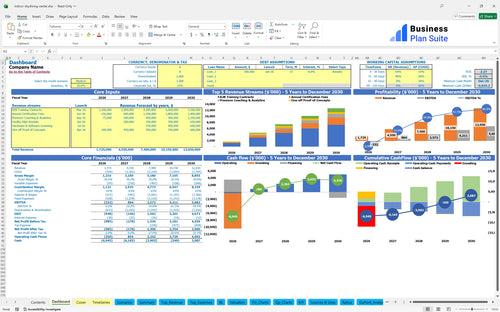
All-in-one Dashboard
Core inputs and core outputs



An indoor skydiving center has its peaks and valleys. This model helps you plan for seasonal demand fluctuations by allowing you to adjust assumptions for customer traffic and B2B contracts, ensuring your financial plan is realistic and resilient throughout the year.
Core inputs and core outputs
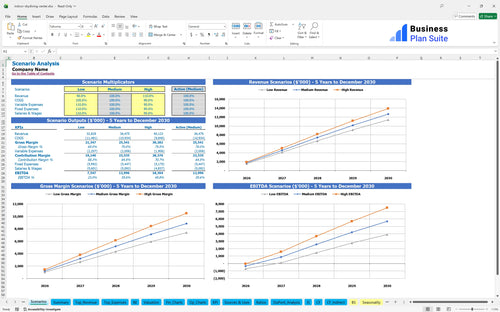
Three scenario analysis
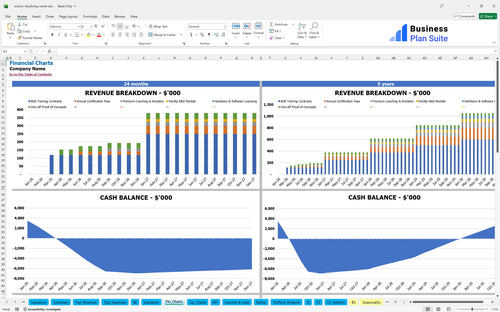
Presentation ready
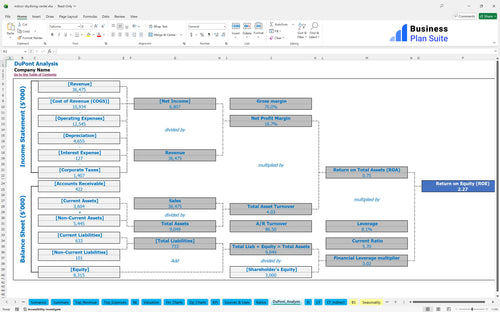
DuPont analysis
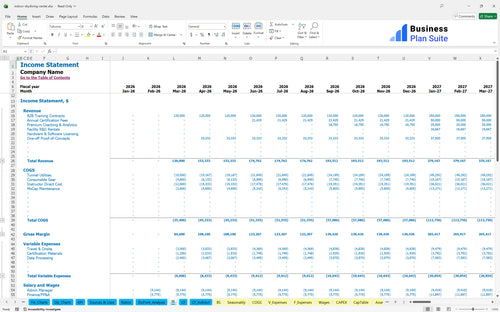
Researched revenue assumptions
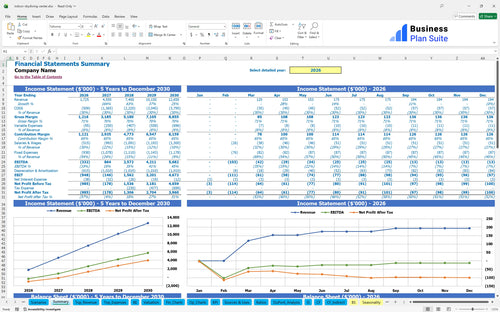
Lender-friendly financial outputs
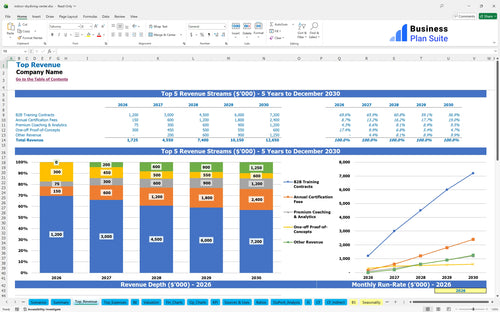
Revenue stream detailed view
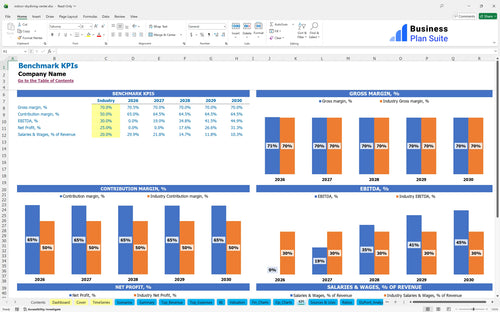
Performance metrics benchmark
We built this startup guide for a vertical wind tunnel training center based on real-world operational data. Key assumptions are pre-filled but fully editable, covering everything from revenue streams to capital expenditures. For instance, the model projects revenue from 80 B2C customers per day at an $85 average price, plus 4 monthly B2B contracts worth $15,000 each, giving you a credible starting point for your own aerial simulation business plan.
You're looking at a net loss of around $450,000 in the first year due to high startup and operational costs. However, the business is projected to become profitable by Year 3, achieving a net profit of $850,000 as you scale B2C traffic and secure more high-value B2B contracts for military or SAR team precision descent training.
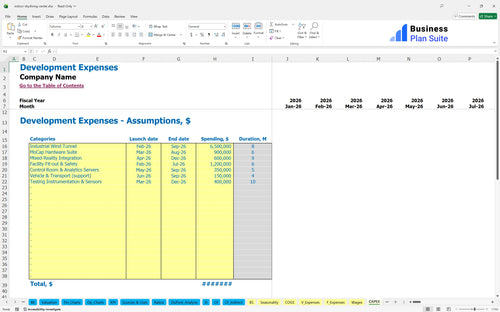
To get this business off the ground, you'll need to raise significant capital. The total initial investment is estimated at $9,500,000. This covers the entire build-out and provides a solid operational runway, a critical part of any wind tunnel feasibility study.
The financial projections show a strong case for investment in your flight training center business plan. Investors can expect an Internal Rate of Return (IRR) of 18.5% and a 5-year Return on Investment (ROI) of 174%. The initial capital is projected to be paid back in just 4.2 years, which is defintely a compelling timeline for a capital-intensive project.
Get a head start on your indoor skydiving business plan with a pre-built financial model. It comes loaded with industry-specific formulas and assumptions for a vertical wind tunnel startup plan, so you can easily adapt it to your unique concept, whether you're targeting recreational flyers or professional flight certification training.
This wind tunnel business plan template provides a clear roadmap for the future. It includes detailed five-year projections for revenue, costs, and profits, allowing you to map out your growth, secure funding, and make informed decisions for your aerodynamic training facility.
Understand exactly what it takes to launch and run your high-fidelity simulation business. The model breaks down all potential expenses, from the massive initial build-out to the day-to-day operational costs, ensuring there are no financial surprises as you get started.
Pinpoint the exact moment your business becomes profitable. The model automatically calculates your break-even point in terms of monthly customers and revenue, giving you a clear target to aim for and helping you manage cash flow effectively in the early stages.
How does your business model for indoor skydiving stack up against the competition? We've integrated key industry benchmarks for metrics like energy cost per flight hour and instructor utilization, so you can compare your projections to established standards and identify areas for improvement.
Work in the environment you're most comfortable with. This financial model is fully compatible with both Microsoft Excel and Google Sheets, giving you the flexibility to work on any device and collaborate easily with your team, investors, or advisors.

Present your financial story with impact using clean, professional dashboards. The model visualizes key data like revenue streams, expense breakdowns, and profitability trends, making your business plan with financial model for flight simulation easy for investors and lenders to understand.
An indoor skydiving center has its peaks and valleys. This model helps you plan for seasonal demand fluctuations by allowing you to adjust assumptions for customer traffic and B2B contracts, ensuring your financial plan is realistic and resilient throughout the year.
This isn't just a spreadsheet; it's a powerful tool for fundraising. The pre-written indoor skydiving business plan Word format and polished financial reports are designed to help you confidently present your vision and secure the capital needed to launch.


Simply purchase and download the financial model template, then access it instantly using Microsoft Excel or Google Sheets. No installation or technical expertise required-just open and start working.

Enter your business-specific numbers, including revenue projections, costs, and investment details. The pre-built formulas will automatically calculate financial insights, saving you time and effort.

Leverage the investor-ready format to confidently showcase your financial projections to banks, franchise representatives, or investors. Impress stakeholders with clear, data-driven insights and professional reports.

Leverage the investor-ready format to confidently present your projections to banks, franchise representatives, or investors.
It usually takes a few focused editing sessions to tailor the template to your needs and avoid research overload the Pre-Written Content and Customizable in Word features let you adapt sections quickly, saving time and consultant fees while keeping investor-ready structure and high-level financial forecasts accessible for immediate use.